
29 October 2010
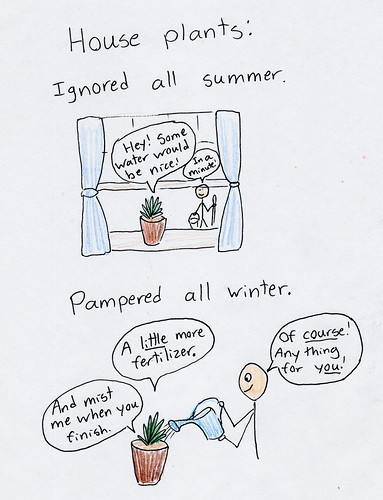
Friday Cartoon: houseplants
Now that we've had a frost, the outdoor garden is beginning to shut down, and my focus has turned elsewhere...


27 October 2010
Why grocery store apples are better than peaches
I was chatting the other day with a friend about 'Honeycrisp' apples. How yummy they are, and how everyone in the apple growing, shipping and selling industry hates them. 'Honeycrisp' is a pain to grow, and doesn't ship or store very well. That is why they cost so much more at the grocery store than the less tasty, but easier to grow, apples next to them.
'Honeycrisp' apples are also interesting because they are a relatively new variety that is actually better tasting than older ones like the infamous 'Red Delicious.' When is the last time you ate a peach or pear or pepper or tomato from the grocery store and thought, "Wow! These are better than what I'm used to!" All the other produce in the store seems to get tougher, drier, blander and less worth eating with each passing year, while apples have actually gotten a little better. Why are apples the exception?
There is one simple reason: Apples are sold by variety. You never go buy "apples," you go buy 'Braeburn' or 'Pink Lady' or 'Gala.' With the actual names of the varieties in front of us, we, the consumers, get to pick the ones we like best. Growers of superior, but difficult, varieties like Honeycrisp can charge more for them to make it worth their while. But look next to the apple section, and you see a big bin labeled "Peaches." That's all. No variety name, just "Peaches." Same with the grapes, tomatoes, peppers, and virtually everything else in the store.
The effect of this lack of variety names was brought home to me a few years ago I got a chance to visit a university research farm where they were testing different varieties of peaches to see which would be best for local farmers to plant. As we tasted through some of the varieties, there was one we all loved called 'Ernie's Choice.' Whoever Ernie was, he knew how to choose, as it is a divine peach -- rich, tender, flavorful and incredibly juicy. Run-down-your-chin-and-ruin-your-clothes juicy. So how did this lovely peach do in the variety trials? Were they recommending 'Ernie's Choice' to all their growers? Quite the contrary -- it ranked as "unmarketable" because it is too tender, too juicey. It can't be harvested and shiped cheaply without damaging it. Anyone growing it would have to charge more for it and no grocery store buyer is going to pay more for them, because without a variety name they have no way to justify charging higher prices to their customers. Grocers are just buying peaches. The cheapest peaches available.
Without variety names attached to our produce, it is a race to the bottom. Whoever can breed and grow the toughest, cheapest, best storing variety wins. If we went to the store and found big bins of generic "apples" you can bet there would be no 'Honeycrisp' in that bin. It would be all 'Red Delicious' or something even worse but even easier to grow. Without variety names our apples would be like our tomatoes, peaches, and everything else at the store, and we, the consumers, would never have the chance to choose taste over price.
I hope that will change -- with the rise of home gardening and farmers markets, I think more and more people are realizing that fruits and vegetables are not just generic commodities, but come in distinct varieties. Hopefully grocery stores will realize it as well, and start telling us what we are actually buying. Maybe we'll even get the chance to buy 'Ernie's Choice' peaches someday.
Addendum: Do check out the comments where WmJas links to the meaning of "Red" in Turkish... Suddenly the name 'Red Delicious' makes so much sense.
'Honeycrisp' apples are also interesting because they are a relatively new variety that is actually better tasting than older ones like the infamous 'Red Delicious.' When is the last time you ate a peach or pear or pepper or tomato from the grocery store and thought, "Wow! These are better than what I'm used to!" All the other produce in the store seems to get tougher, drier, blander and less worth eating with each passing year, while apples have actually gotten a little better. Why are apples the exception?
There is one simple reason: Apples are sold by variety. You never go buy "apples," you go buy 'Braeburn' or 'Pink Lady' or 'Gala.' With the actual names of the varieties in front of us, we, the consumers, get to pick the ones we like best. Growers of superior, but difficult, varieties like Honeycrisp can charge more for them to make it worth their while. But look next to the apple section, and you see a big bin labeled "Peaches." That's all. No variety name, just "Peaches." Same with the grapes, tomatoes, peppers, and virtually everything else in the store.
The effect of this lack of variety names was brought home to me a few years ago I got a chance to visit a university research farm where they were testing different varieties of peaches to see which would be best for local farmers to plant. As we tasted through some of the varieties, there was one we all loved called 'Ernie's Choice.' Whoever Ernie was, he knew how to choose, as it is a divine peach -- rich, tender, flavorful and incredibly juicy. Run-down-your-chin-and-ruin-your-clothes juicy. So how did this lovely peach do in the variety trials? Were they recommending 'Ernie's Choice' to all their growers? Quite the contrary -- it ranked as "unmarketable" because it is too tender, too juicey. It can't be harvested and shiped cheaply without damaging it. Anyone growing it would have to charge more for it and no grocery store buyer is going to pay more for them, because without a variety name they have no way to justify charging higher prices to their customers. Grocers are just buying peaches. The cheapest peaches available.
Without variety names attached to our produce, it is a race to the bottom. Whoever can breed and grow the toughest, cheapest, best storing variety wins. If we went to the store and found big bins of generic "apples" you can bet there would be no 'Honeycrisp' in that bin. It would be all 'Red Delicious' or something even worse but even easier to grow. Without variety names our apples would be like our tomatoes, peaches, and everything else at the store, and we, the consumers, would never have the chance to choose taste over price.
I hope that will change -- with the rise of home gardening and farmers markets, I think more and more people are realizing that fruits and vegetables are not just generic commodities, but come in distinct varieties. Hopefully grocery stores will realize it as well, and start telling us what we are actually buying. Maybe we'll even get the chance to buy 'Ernie's Choice' peaches someday.
Addendum: Do check out the comments where WmJas links to the meaning of "Red" in Turkish... Suddenly the name 'Red Delicious' makes so much sense.
25 October 2010
Sciency Answers: Mycrorrhizae
Liz, of Ginkgo Grass, sent a question:
Does adding mycorrhizae to a garden help? I have heard that there is plenty in the soil, and the only good use is for sterile potting mix.
Does adding mycorrhizae to a garden help? I have heard that there is plenty in the soil, and the only good use is for sterile potting mix.
Thanks,
Liz
The short answer is that you are right. But there is a longer answer, and it is much more fun.
Soil biology is incredibly complex, with every handful of healthy soil containing many species of bacteria, fungi, protists and nematodes, many still unknown to science. We know that many of these soil organisms for beneficial, mutualistic or even symbiotic relationships with plants, but the sheer complexity of these interactions is just beginning to be unraveled. Several species of fungi which form close, beneficial, association with plant roots (mycorrhizae) have been identified, and adding these fungi to soil has shown benefits, in a few specific situations.
The first situation is in sterilized soil or soilless media in pots. This isn't particularly surprising -- when you start with sterile soil, adding a beneficial fungi can be helpful. But frequently the results aren't dramatic, or significant in normal conditions. Which isn't surprising either -- mycorrhizae help plants primarily by acting like extensions to the root system, scavanging up scare nutrients (especially phosphorus) and water. In very poor, acidic soil, this can be the difference between a plant living or dying. In a carefully watered, fertilized container, it doesn't have much effect.
The other situation where adding mycorrhizae can be beneficial is best illustrated by a story (taken from Soils in Our Environment by Duane Gardiner and Raymond Miller): People tried transplanting pine trees grown in the US in Puerto Rico, but they only grew a few inches and died. The problem was solved when some soil from a pine-growing part of the US was taken to Puerto Rico and used to inoculate the soil there. The mycorrhyzae from the US soil hooked up with the pine roots, and hey presto, they grew 2.4 meters in a year rather than 30 centimeters. This case worked because the mycorrhizae used were species specific. These pines needed this specific fungi in order to thrive in particularly harsh conditions, namely, extremely nutrient poor tropical soils. Adding some generic "helps everything grow better!" commercial mycorrhizea product to those pines wouldn't have helped because it wouldn't have been the specific species those pines needed. And adding even the right species of mycorrhizae to the soils in the US wouldn't have done any good either -- because it is already naturally in those soils. I should add here: This story makes a good point, but you should follow their example. Moving soil around to get mycorrhizae VERY BAD IDEA! Soil from where a plant grows naturally may have beneficial mycorrhizae. It also probably has all sorts of soil born diseases which you do NOT want to be helping spread around. You don't want to be the person who introduced the soil equivalent of kudzu to a new area.
So the take home message is: mycorrhizae in potting soil might be beneficial, but I wouldn't expect to see a huge effect. If you are curious, it might be fun to give it a try, but be sure to keep an untreated pot for comparison. Also, check the label to see if the mycorrhizae treatment also includes fertlizers, which of course will result in added growth, but not because of the inoculation.
Adding mycorrhizae to good garden soil will probably do nothing unless it is a specific mycorrhizae for some specific plant that isn't native to your area. Any product claiming to be a generic helpful mycorrhizae that will make all your plants grow better is going to be (almost certainly) a waste of money.
If you do want your plants in the ground to grow better, your best bet is to keep your already existing soil organisms happy with lots of organic matter and mulch.
Have a question? Get a sciency answer! Just e-mail me: engeizuki at gmail dot com
Have a question? Get a sciency answer! Just e-mail me: engeizuki at gmail dot com
Subscribe to:
Posts (Atom)