I know I'm crazy but I just couldn't resist.
My pink dandelions are blooming!
Aren't they fun? These are Taraxicum pseudoroseum as opposed to the common lawn weed, Taraxicum officinale.
Now that they are flowering, I'm wondering if they will successfully naturalize in the lawn like their yellow relative. I'm seriously tempted to grow up a bunch and plant them out in the front yard in place of my regular yellow ones. It would be so much fun to watch people walk by and do a double take!
Showing posts with label weeds. Show all posts
05 May 2011
27 July 2010
Wild flowers: Rudbeckia and rumex
I've talked about the wildflowers along my daily bicycle commute before. Well, right now they are putting on quite a show again. Black eyed susan (Rudbeckia fulgida I think. I'm never sure on rudbeckia species) and behind it the weed, curly dock (Rumex crispus) with a few unidentified grasses mixed in.
I would never think of letting dock in my garden, but I have to say the brown of the dried seed heads forms an amazing back drop for the rudbeckia flowers. Once again, nature proves to have very sophisticated tastes in design.
Labels:
design,
dock,
rudbeckia,
weeds,
wild flowers
24 May 2010
Dame's rocket
The wildflowers along my daily ride into work are, once again, outdoing the best gardeners. Here are a couple shots of the sheets of dames rocket (Hesperis matronalis) making parts of the woods lovely (and incredibly fragrant) right now.
Before I gets lots of angry comments: Yes, I know it isn't native. I also can see it is far from forming a monoculture, as there are lots of other plants in these stands that it is getting along with just fine, and I've only seen it in large numbers in disturbed, road-side areas like this. I'm certainly not going to spread it to areas where it isn't already growing, but I don't see any harm in enjoying its beauty.
Labels:
good plant bad plant,
Natives Project,
weeds
19 May 2010
Variegated weeds
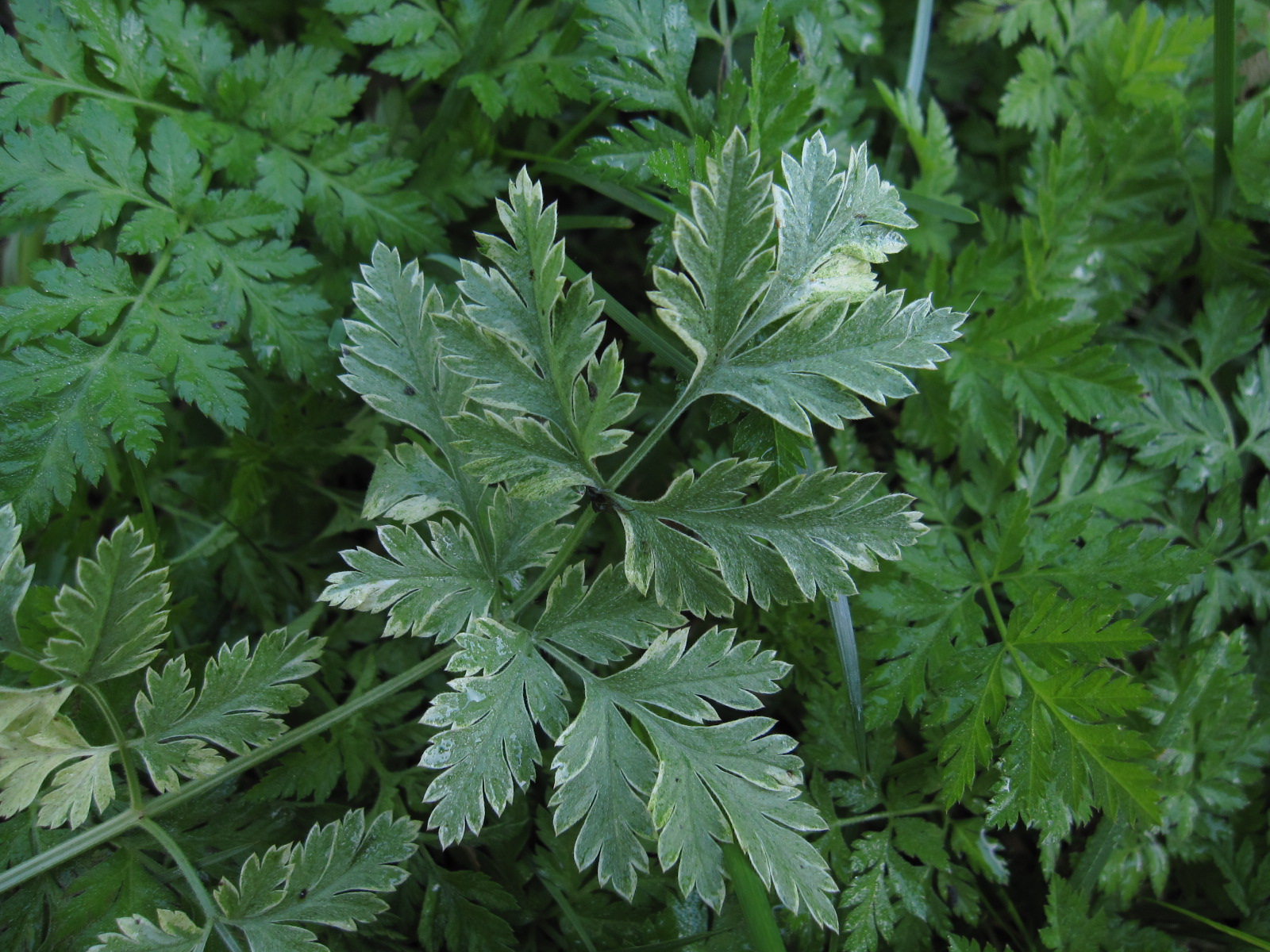
Virtually all variegated plants on the market are found as chance mutations in a garden or nursery -- so I always keep my eye out for leaves that look different on the off chance that I'll find something exciting.
This past weekend I found not one but TWO variegated plants in my yard. Both weeds, sadly, but still, cool all the same.
This variegated queen anne's lace (Daucus carota) shown here against its plain green neighbors, is actually quite pretty, I think. Sadly, it is a biennial, so the only way to propagate it would be by seed, and this type of variegation is virtually certain not to come true from seed.
This narrow leaf plantain (Plantago lanceolata) has variegation that looks unstable -- half the leaves are variegated, half aren't, but I'm hopeful it will stabilize with white leaf margins. Plantain is a perennial, so propagation would be no problem, and really, it looks more like a rare and expensive hosta than a weed! Of course, it will still seed around like a weed, and have plain, green children... but still. Pretty cool. Now if only the non-weed residents of my yard would follow their example and throw variegated sports as well I would be REALLY excited.
This past weekend I found not one but TWO variegated plants in my yard. Both weeds, sadly, but still, cool all the same.
This variegated queen anne's lace (Daucus carota) shown here against its plain green neighbors, is actually quite pretty, I think. Sadly, it is a biennial, so the only way to propagate it would be by seed, and this type of variegation is virtually certain not to come true from seed.
This narrow leaf plantain (Plantago lanceolata) has variegation that looks unstable -- half the leaves are variegated, half aren't, but I'm hopeful it will stabilize with white leaf margins. Plantain is a perennial, so propagation would be no problem, and really, it looks more like a rare and expensive hosta than a weed! Of course, it will still seed around like a weed, and have plain, green children... but still. Pretty cool. Now if only the non-weed residents of my yard would follow their example and throw variegated sports as well I would be REALLY excited.
Labels:
good plant bad plant,
just strange,
weeds
Subscribe to:
Posts (Atom)