22 February 2016

Rare Woodland Wildflowers available now - extremely limited supply

We've got our hands on some exceedingly rare woodland wildflowers for sale -- all native to the eastern US. These are first come, first serve, in limited supply! Many of these species have rarely seen widespread circulation in the nursery business before.

Our supply is limited, so if you like what you see here, head on over to our shopping cart and snap yours up before someone else does!


Click picture to view on our store.

Trillium pusillum:

An extremely rare species of Trillium with flowers in white to soft pink and flowing, undulate petal margins. For as rare as this Trillium is, it's very easy to grow, and germinates easily from seed, reaching maturity quickly.


Click picture to view on our store.

Actaea pachypoda:

In late summer this easy-to-grow, deer resistant native woodland perennial produces big clusters of beautiful, long-lasting (if the birds aren't too hungry) white berries each with a small black spot on them which gives them the slightly creepy, but descriptive, common name of “Doll's Eyes.”


Click picture to view on our store.

Goodyera pubescens:

One of the most unusual and beautiful of our native orchids. The flowers aren't much to write home about – small, white, but the evergreen foliage is absolutely gorgeous, dark green overlaid with a network of bright white veins. Easier to grow than many orchids, best in shaded woodland conditions.


Click picture to view on our store.

Cyprepideum aucale:

The iconic and elusive pink lady slipper. Not easy, but growable in the right conditions. Acidic, humus-rich woodland soil will be your best bet. Very rare.


Click picture to view on our store.

Trillium wallpolei/billingtonii:

These are seed grown plants from a population collected here in Michigan years back. The land was slated to be cleared for a parking lot, but this selection was collected first. A very unique flower that loves to form strong clumps in the garden -- and something I don't think you'll ever find at another nursery. As for the name, the taxonomy is a little grey but it's now considered to be a hybrid between the northern T. flexipes and T. erectum.


Click picture to view on our store.


Panax quinquefolium:

American Ginseng, much in demand for use in herbal medicine, and well worth growing for the very show bright red berries in the late summer and fall. Becoming rare in the wild due to unscrupulous collecting, and very rarely available in nurseries because it is slow to propagate, so if you want it, snap it up, as this will be one of your few chances.


All of these beautiful, rarely seen species are available here, at the Arrowhead Alpines online store. Spring is nearly here, and that means the time to get your wildflower orders in is now! We can guarantee that what we have on sale today, you won't find in your neighbor's garden, nor at any local garden center.

Don't forget, while checking out these new specials that the deadline for placing an order for any of our BULK woodland wildflowers is rapidly approaching -- if you require Spring delivery especially. Orders for Spring delivery on the BULK wildflowers must be placed before March 7th! It's a great time to bundle together an order for some of our bulk wildflowers and some from our rare limited wildflower sale.


23 January 2016

Winter Happenings at Arrowhead

Daphne cuttings, seed germination, winter grumbling, and much more


Also -- winter specials ending January 31st (click for links):


Winter -- the best time for propagating Daphnes!


For once, extreme winter weather is in the news and it ISN'T in Michigan! All you East Coasters getting buried under massive amounts of snow… welcome to our life. We did that the last two winters. This year we're enjoying moderate snow and reasonably average temperatures. Hopefully if the trend continues, we'll soon be able to enjoy our new ocean front property in mid-Michigan.


Global warming won't stop our Daphne propagation, anyways.


As much as we all love to complain about winter, it is an important part of Arrowhead's schedule. For one, if we had to be watering and weeding 12 months a year, we'd probably go insane. A little winter break when everything is dormant and frozen solid isn't a bad thing.

Winter is also our key time for propagating Daphnes. We cut them at various times, but one of the best is early January. Cuttings brought in from the cold and stuck in a warm, bottom-heated cutting frame come out of their winter dormancy and start growing roots in a hurry.


Some of our prized D. calcicola cuttings, growing in a bottom-heated frame

Well, in a hurry for a Daphne. There is a reason we're about the only nursery that grows many of these things. They're a pain in the ass pretty much from the moment you take a cutting until the time you plant them in the garden. But they're OUR pain in the ass, and once they do get put in the ground, provided they've got excellent drainage, they are so ridiculously beautiful and non fussy that it is impossible not to love them.

Daphnes, as hopefully you know, transplant best when they are tiny, so every year we're sticking big batches of all of our favorites so that come spring we'll have the best, most vigorous plants to ship out to our customers. After those cuttings are a couple years old, they may look bigger and fuller, but they simply don't transplant well -- to the chagrin of everyone involved.


Warning: big, cool looking Daphne photos incoming:

D. calcicola in bloom
D. calcicola in bloom, close up

In addition to all our usual offerings, we've been working on taking cuttings of some of the very rarely available yellow flowered Daphnes, D. calcicola (seen above) and Daphne gemmata (aka Wikstroemia gemmata). These guys are never easy to produce, but fingers crossed we'll get enough rooting that we'll be able to list them this spring!

Some of our cuttings of Daphne gemmata, also known as Wikstroemia gemmata
The impressive cream-yellow flowers of D. gemmata

If any of this Daphne-talk has piqued your interest, head on over to our shopping cart here and take a look at some of the new offerings we've been adding over the winter. And of course you can find many of our wonderful selection of Daphnes on tap at this link here. Don't forget you have until the end of January to use our winter coupons:
  • Either enter the code ‘SNOW’ at checkout and receive 20% off your entire order (excluding our collections, grafted conifers, and bulk wildflowers)
  • Or enter the code ‘ICE’ at checkout to get free shipping.
As always, we will hold your orders placed now until spring when the weather has thawed and planting may begin.

28 August 2015

20% off trees and shrubs clearance sale!

 Who needs flowers if you can enjoy the brilliant fall foliage that only shrubs and trees can provide.


Fall will be arriving soon, and we've put together a sale to accommodate your need to add some color to your garden.


Liriodendron tulipifera, Stewartia pseudocamelia and Daphne x Burkwoodii 'Silveredge'

Here at Arrowhead we're trying to downsize and refocus on doing what we do best: alpines. To that end, we're doing a massive sale on our trees and shrubs to clear out the stock. Order now for trees and shrubs shipped through November, and take 20% off. You can also stop by the nursery in person and still receive our trees and shrubs discount. And if there is something in our catalog you've been wanting and putting off buying, now is the time, as once they're gone, they're not coming back.


 For example, you won't want to miss Weigela subsessilis'Canary' which is worth growing for the very unusual soft yellow flowers, but is also the most vigorous, winter hardy Weigela I know, blooming its head off after even the harshest winters.


Or Abelia mosanensis, with abundant fragrant pink tubular flowers, white on the inside giving a unique two tone effect in spring. Fall color is an excellent orange red which tends to develop late. The flowers in midsummer hold the crown as the most popular shrub in the nursery with butterflies of all types.A deciduous Korean species, it is considerably hardier than the evergreen species.


Or end your season with the late summer glory of Heptocodium miconoides 

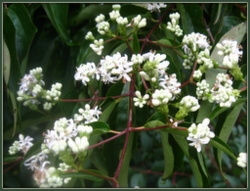
A cool new plant introduced from China in 1980, although Wilson found it back in 1907. Ornamental peeling Crepe Myrtle-like bark, fragrant white flowers in late summer in six flowered whorls terminated by a single flower (hence Heptocodium) followed by showy cherry red calyces surrounding the fruits, giving the impression of still being in flower in autumn when the leaves turn purple.  
Despite what Dirr says it seems to thrive in full sun, and struggles in the shade at least in the north.