Showing posts with label breeding. Show all posts

21 November 2012

AHHH! My book has a cover!

My editor at Timber Press sent me this yesterday:

The cover design for my book! I still don't quite believe that this is happening... But it is! Coming out in March and... even MORE insane, you can already pre-order it on Amazon. I'm going to be an author! 

29 January 2012

Baby picture!

What's cuter than a baby picture?
Aw.... the widdle cutie pie! Sooooo sweet!


Here's the proud mama, the daughter of the first hybrid I ever made, a cross between the wonderful native US swamp rose, Rosa palustris and a beautiful rugosa rose hybrid called 'Apart'. She's an incredibly tough little lady, a vigorous, incredibly thorny bush that laughs at disease and, thanks to the fact her grandmother lived in a bog, thrives in heavy, poorly drained clay soil. In contrast to her tough-as-nails constitution, all summer long she unveils these delicate, fragrant, exquisitely crafted flowers that I adore.
This is the daddy, the classic, and classy, rose 'Golden Wings' one of my favorites with pale yellow blooms on a large, vigorous bush.

I'm so proud to welcome their first child into the world! More should be popping up soon, and I can't wait to see what they look like and how they grow. So much beauty and anticipation packed into a tiny speck of green!

13 January 2012

Quick link: Plant breeding ain't hard

I'm always going on about plant breeding. I love it. It is a blast. I'm writing a book about it. It is also sometimes incredibly easy, as easy as letting violas self sow and picking out your favorites as they bloom. To see how much fun (and how lovely) that can be, go check out Faire Garden's gorgeous (and amusing) Viola Beauty Pageant. Anything with some variability that self-sows in your garden -- be they violas, columbine, or even lettuce -- can be treated the same way to create your very own strain. Collect some up, let them get down and dirty together, and pick out your favorites!

21 November 2011

Creating New Heirlooms (Plus: Exciting news!)

Recently, I was telling a friend about my deep and abiding love for Russian tomatoes. I've grown several, and they have a distinctively rich flavor, often a beautiful dark color, and are well adapted for the cool, short summers of Michigan. 'Black Krim' is my favorite of the ones I've tried (though I think it is technically Ukrainian), and whenever I see the words like “heirloom from Russia” in a catalog, I pretty much know I'm going to like it.

That conversation got me thinking. I love Russian (and Ukrainian) tomatoes, but of course tomatoes don't really come from Europe at all. Tomatoes are native to South America, and, like a host of other delicious things (beans, squash, peppers, potatoes, eggplant, corn...) only made it to European gardens and tables after Columbus opened the new world to European explorers. Tomatoes, when they were first arrived in the old world, were a mix of varieties adapted to grow in warm South and Central American climates and selected for use in local food traditions and culture. Once they arrived in Europe, however, local gardeners took them on and made them their own. By saving seeds from varieties that performed well in their local climates and local cuisines, Italians created heat-loving, red, often green-shouldered varieties with a bright, clean taste, while Russians (and their neighbors) perfected cool tolerant, dark fleshed “black” tomatoes with a rich, smokey flavor.
Italian food. Plants from around the world.
As Europeans immigrated to the United States, they brought with them the varieties of tomatoes (and other plants) they grew up with in their home communities, and here they have continued to evolve. Just as Russian and Italian cultures and climate created distinctive tomato types, the melting pot of America brought a whole range of European heirlooms together to create distinctly new varieties, like the famous and wildly popular Brandywine tomatoes which came into being in gardens in Ohio and Tennessee.

It isn't surprising to me that the Brandywines, and other homegrown heirlooms like the Mortgage Lifter varieties, are so popular here in the US. After all, they were created here, the product of our culture, just as different European and Asian cultures have created their own specific takes on tomatoes that reflect their different values, cooking styles, and ways of life. Heirloom varieties are more than simply a crop, they are the result of a long, dynamic partnership between plants and people that has been going on since agriculture began. Weedy grasses give up life in the wild to become wheat and corn, one little plant scientists know as Brassica oleraceae morphed into myriad forms gardeners call broccoli, cabbage, kohlrabi, Brussels sprouts, and cauliflower, and of course, tomatoes sailed around the world to form a perfect partnership with Italian pasta.
Corn, before it teamed up with humans
Unfortunately, many gardeners today have given up their part in this ancient collaboration, ceding their role in the on-going evolution of the plants in their gardens to corporate breeders. Corporation, as they tend to do, have set out to replacing the endlessly diverse, personal forms of heirloom varieties created by and for a local community with new varieties which are efficient, uniform, and score well with focus groups.

This story has been told many times, and many gardeners have turned to growing historic heirloom varieties in response. But that is only half the solution. We've worked hard to preserve what previous generations have created. Now it is time to bring back the very art of that creation itself.
Pollinating tomatoes
Some gardeners are beginning to do this. Heirloom tomatoes came into being when their were fewer people in the world and have huge, sprawling vines that don't fit well in today's small yards or patios. A few years ago, a some gardeners were looking for delicious, beautiful varieties for their small gardens, and decided to do something about it. They got on-line and created the Dwarf Tomato Project, working as a community to breed a new generation of delicious heirloom-style tomatoes for small spaces. I love that, and I want it to spread. It is time we took back our plants, started making varieties for us, created by our friends, in our community, adapted to our local climate, soil, and tastes. It is time we started creating new heirlooms.

Which brings me to the big news of today's post. The working title of my upcoming book for Timber Press is Creating New Heirlooms, and it is going be all about the concepts I just outlined in this post. I'm super excited about it, and hope you are too!

23 September 2011

Friday Video: Bearded irises through time

I'm fascinated by how plants change through time in the hands of human breeders and gardeners. So I decided to make a little video to better visualize it. I went through the American Iris Society Wiki (http://wiki.irises.org/) and grabbed images of 189 varieties introduced in the last century, more or less distributed evenly across the decades. String them together in a video, and you can watch how breeders have modified bearded irises over the last 100 years. Most dramatically, the falls get shorter and rounder, and the petal edges get ever increasingly frilled and ruffled.

It is pretty cool, if you are a breeding nerd like me. I'm sure the flowers are getting bigger as well, though you can't see it in this video, since the flowers are not to scale. I'm also realizing that I think I like the mid-century varieties better than the super frilly modern ones. Which did you like best?

04 September 2011

Growing a bit of ancient history.

One of the reasons I love gardening is for the connection to history. My personal history of grandparents who gardened, but also the greater human history, those early gardeners who first realized they could take a bit of ground and make it into something called a garden. That is why, this spring, I planted these seeds.
You all know the seeds on the right. It is corn, of course, known scientifically as Zea mays. On the left we have... Zea mays, only this one goes about under the common name teosinte, and is the wild Mexican grass that Native American farmers started with to breed the corn we know today. When I requested these seeds, I knew they would look different, but I never expected it would be so dramatic!
This is them in my garden (please forgive the lousy picture) Teosinte on the left, again, with more stems, and looking more like a typical grass than the thick, single stem of the corn on the right.

And now, as summer winds down, my teosinte is beginning to make ears. Here they are:
I can't quite wrap my head around this. That little stack of seeds, those few brown silks... THAT was transformed by prehistoric gardeners, with no knowledge of genetics, into the huge beefy ears of corn with all its colors and shapes and sizes that we know today. Surely the greatest plant breeder the world has ever seen was some native American whose name we will never know.

Teosinte isn't particularly attractive, or edible, but I'm very glad I grew it this year. It makes me really take a moment to think about -- and be thankful for -- the amazing gardeners who created the plants that feed our world today.

10 August 2011

Go ahead, save seeds from your hybrid tomatoes!

Everyone knows you can't save seeds from hybrid varieties. It is practically the first thing you learn as about seed saving. Too bad it isn't true. Not only can you save seeds from a hybrid tomato and many other vegetables and flowers, the result will usually be something you'll like better than the hybrid you started with.

F1 hybrid varieties were first created because they have hybrid vigor, which is just another way of saying that they aren't inbred. Inbreeding, as we all know, isn't a good thing, generally resulting in unhealthy individuals. That's why we don't marry out sisters and why purebred dogs don't live as long as mutts. F1 hybrid varieties are a way to bring the health of mutts to a uniform variety. (How that works).

In the plant world, however, things are a little different. Some plants, like corn, are called outcrossers and act like us and dogs. Their flowers are set up in a way to maximize the chance that they get pollinated by another, hopefully unrelated, plant. These types of plants show very strong inbreeding depression, so hybrid varieties are significantly more vigorous than an inbred equivalent. Other plants, including tomatoes, peppers, beans, and lettuce, are selfers. Rather than working hard to get the wind or bees to carry their pollen to another flower, they just self pollinate, naturally inbreeding in the most extreme way possible. As a result, their genomes have adapted to tolerate inbreeding, meaning hybrids varieties don't show significant increase in vigor.

Why then, hybrid tomato varieties? Why do seed companies go to all the effort of hybrid seeds when a inbred variety would work just as well? Simply put, because you “can't save seeds from them.” Introducing hybrids is a way for plant breeding companies to protect their varieties from other companies taking what they've created. Since 'Early Girl' is a hybrid, the only way to produce more 'Early Girl' seeds is to have access to the two parent plants used to create it, parent plants that you can bet Burpee is very careful no one else is ever going to get ahold of.

When you save seeds from a hybrid variety like 'Early Girl', you'll get a range of different plants, none will be exactly the same as 'Early Girl' itself. Fruits will be a little bigger or smaller, sweeter or tarter, everything will differ to some degree. However, the traits you saw in the F1 parents plant will be essentially the C average for what you'll see in next generation. Despite the variability, it usually isn't hard to select out a plant that is very similar to the hybrid variety you liked so much.

It is even easier, though, to pick out a plant that you like better than the hybrid variety it came from. Professional breeders have create varieties based on what they think the average gardener and will grow over as wide a part of the country as possible. But you aren't an average gardener, and you only garden in one spot. Maybe you'd like something bigger for slicing on a sandwich or something smaller for eating out of hand, sweeter or more acidic, drought tolerant or the ability to grow through chilly wet weather. Grow out at least half a dozen seedlings from a hybrid variety, and you get the chance to customize it for your climate, your soil, and your tastebuds. Keep saving seeds from your favorite individuals, and after a few years, you'll have a new variety, one that will perform and taste better for you than the hybrid it came from. Give is a name, share it with your friends, pass it on to you children, and you've just created your own heirloom.

Go ahead. Save those seeds!

05 July 2011

Seedling's first flower!

Well, at long last, the first flower of my little rose seedling has opened!

Its mother looks like this:

And the daddy looks like this and boast the strongest fragrance of any rose I know:
And here is the first flower of their little baby:
It is a bit scruffy looking, but that will probably change as it matures. The first flower of a new rose seedling usually has fewer petals than the blooms from a mature plant, and the extra petals can significantly change the form and look of the overall bloom.
The good news is that the fragrance is outstanding! To my nose, almost as strong as its delightful father, which is saying something.

This cross resulted in about what I had expected, but that isn't always the case. Whenever you make a cross, odd, unexpected stuff pops out. Sometimes it is good, sometimes not so much. But I got lucky this time with one of my other seedlings from the same cross. It germinated much later, so no flowers yet, but it has stunningly lovely blue-grey leaves, very very like Rosa glauca. Totally unexpected color, and very welcome! I can't wait to see what the flowers look like. Probably pink, like its sibling, but it could be different. In any case, I'll have to cross it with a bunch of my other favorite roses. Wouldn't a dark, rich, smoldering red flower look stunning on a bush of those leaves?

22 June 2011

Chef + plant breeder + mint = exciting new flavors

Longtime readers will know that I love the intersection of plant breeding and great food, which is why I was so excited when looking through Richters Herbs' website, I noticed their mint offerings. I know the usual varieties: spearmint, peppermint, apple, pineapple, and chocolate mint, but here was a whole new range of mints with names like 'Candy Lime', 'Wintergreen', 'Berries and Cream', and even 'Oregano-thyme'! Reading the descriptions got me even more excited. These are part of a whole series of varieties developed by one Jim Westerfield who, in addition to being a plant breeder and mint enthusiast, is creator of an award winning gourmet restaurant, Westerfield House! I had to order some.
As soon as the box arrived, I pulled them out and start sniffing and nibbling my way through the selections. I wasn't disappointed. We're talking whole new sets of flavors here. I can't wait to start cooking with them! And they're mints, which means easy (sometimes too easy...) to grow!

Here are the 5 varieties I ordered, and my comments on them:

'Wintergreen'
I was skeptical about this one... really? Wintergreen? The dominate flavor is still mint, but there is a pronounced real winter green flavor as well! It also must have a really high methol concentration, because chewing a leaf fills your mouth with that distinctive tingly cooling sensation. I love making mint lemonade... this variety would be perfect for it! Or a mint-berry smoothie! Or... so much more! I hope this guy is a vigorous as most mints, because I'm going to be harvesting a lot of it.

'Oregano-thyme'
Again, I had to order this one because I couldn't quite believe it. Chewing a leaf, I don't know if I'd say oregano or thyme, but the flavor is definitely some sort of cross between mint and something of the rosemary-oregano-sage-thyme ilk. It really feels like a NEW flavor to play with! I can't wait to get it in the kitchen.

'Candy Lime'
This one is delicious. I mean, really, really delicious. Perhaps my favorite flavor just nibbling the leaves straight off the plant. It does indeed have a hint of lime to it, enough to make my boyfriend instantly say "Mojito!"

'Fruit Sensations'
I was a little disappointed here. This one tastes like mint. A very good mint, but nothing extraordinary. In other company, I would probably rave about it, but when the others are so delicious, I don't think I'll really ever use this one.

'Citrus Kitchen'
This one is also quite delicious, and surprisingly has a definite orange flavor to it. My first thought was that this is what I wish mint chocolate chip ice cream tasted like. Now I might have to get an ice cream maker... The tag recommends putting it in orange juice. I might just have to try that.

17 June 2011

The mystery, discovery, and joy of breeding roses

All my roses are covered with different colored strings!
Why strings? Because, after nearly a decade, I've become re-interested in rose breeding, and all those little strings are marking developing hips I pollinated over the past couple weeks.

Roses were my first love when I got seriously into gardening and breeding as a teenager, but somehow the romance faded and I focused on other things. The, last year, on a whim, I made a couple crosses between some of my very favorite roses. And once I had seedlings germinating, all the excitement and joy of the relationship when it was new came flooding back, and I knew I had to start crossing them again.
Now I've got this, perhaps the most exciting thing there is in the world. The first bud on a seedling rose. Inside that tiny bud is a flower, never been seen before in the world. I'm hoping, hoping, it will be fragrant  and richly colored, but I don't know. No one knows. This new rose awaits discovery. And next year, I'll have LOTS more mysterious new roses unveiling their unique beauty for the first time before my eyes. Ah, the JOY of rose breeding!

28 February 2011

People are addicted to tomatoes

I joined the Seed Savers Exchange a few months ago, and was excited to get the annual Yearbook in the mail a couple days ago. It is big -- 482 pages of rather fine print descriptions of plant varieties people have available.

I was rather curious to see what sorts of things it has, and have enjoyed it a lot. It is all fruits and vegetables,with a wide range of family heirlooms, and even more exciting to me, a surprising number people's personal breeding projects. I instantly gravitated to options like Kale 'Gulag Stars' which is described as: "Incredibly diversity unlike anything else, a mix of napus kales that have been crossed with B. rapa, bud pollinated by Tim Peters of Oregon to bypass species incompatibility mechanisms, crazy diversity of colors and shapes." (if you are not a SSE member, it is also available here) Be still my beating heart. How can I resist ANYTHING described as having "crazy diversity of colors and shapes" especially if it is the result of a cool and difficult to make interspecific cross? I'm such a plant breeding nerd...

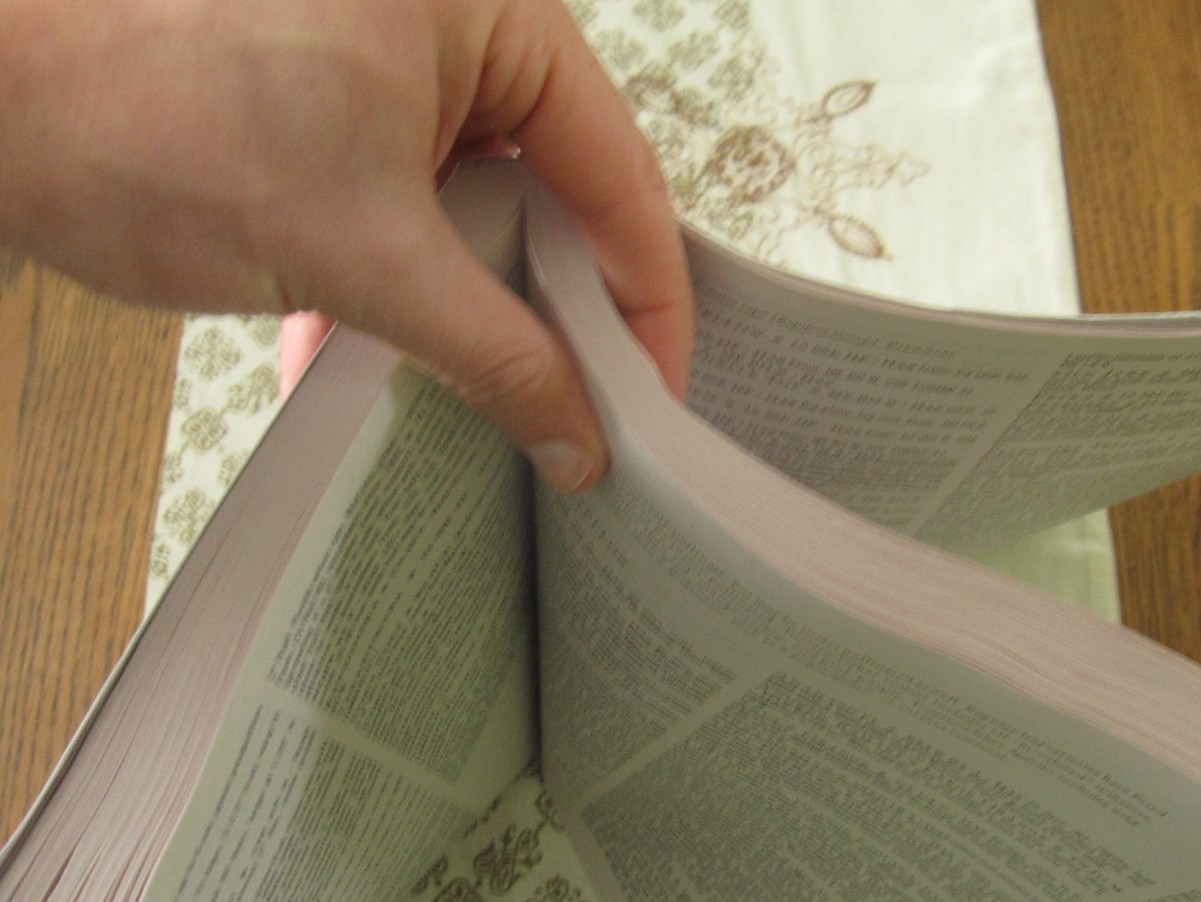
I was a little surprised, though, when I got to the tomato section. I love a good tomato, but seriously? There is some insanely tomato love going on here. This is me holding the section of the book devoted to just listings of tomato varieties:

Fully 200 of the 482 pages with nothing but tomatoes. It is almost enough to make me stop breeding tomatoes and start focusing on everything else... tomatoes are good, but spread the love, people!

22 November 2010

Breeder's Provenance (or, why delphiniums and those new echinacea are so whimpy)

I got thinking about insufficiently tough delphiniums and echinacea after I read Kelly Norris talking on his blog about the concept of provenance. The concept is pretty simple. Any given species of plant grows across a range of habitats and we refer to individual plants from different parts of the range as have different provenance. And provenance matters. To give an extreme example, Acer rubrum, the red maple, has a native range that stretches from frigid Maine right on down to sweltering Florida. They are all the same species, but individual trees can be very, very different depending on their provenance. A red maple from Maine can't survive Florida summers, and a Floridian red maple would collapse at the first hint of the Maine winter. Each local population of the species has evolved over time to match its local environment, gradually loosing or gaining heat or cold tolerance genes, slowly becoming better adapted to the climate and soil in one specific area and less adapted to different environments.

That is the real concept of provenance. I'm going to talk about something else all together and call it "breeder provenance" but you should be aware that I am completely making this term up.

The connection to real, biogeographical, provinance, however, is very close. Just as wild populations of a species become adapted to their local enviroment, cultivated plants, under the hands of plant breeders, become adapted to the environment where they were bred. These varieties develop a breeders provinance. Case in point: delphiniums. Delphiniums are, of course, almost obsenely lovely -- huge, lush spikes of rich, true blue. As a beginning gardener, I wanted to grow them rather desperately. Then I learned, the hard way, that in addition to being beautiful, they are drama queens. They demanding perfectly rich, moist soil, and miserably whimper away and die at the faintest hint of heat in the summer. Looking at my rows of corpses, I asked myself: Why is it that so many insanely beautiful things seem only willing to grow in England?

Pretty soon I learned the answer: Because they were bred in England. Or, in the case of some, the ever-mild West Coast. If you go back to the various wild species of delphiniums, they are far from all being cool-summer whimps. The stunning six-foot spires of Delphinium exaltatum, one of the species thought to be used in creating the modern hybrid delphiniums grow wild in the mountains of hot North Carolina. Another US native, Delphinium carolinianum, far from demanding cool, moist loam, grows wild all over the great plains and even down to the sand hills of Florida. Modern cultivated delphiniums are not such a pain to grow because that is how they have to be, rather, they have simply adapted over the years of breeding to the conditions where they have been bred: lush gardens in England and California. In other words, the breeders provinance is all wrong, and just like the red maples growing in New England, they've lost the ability to cope with the heat.

The same thing appears to be happening right now with the (formerly) tough-as-nails midwestern native, echinacea. In the wild quest for new colors and forms, the simple cone flower has moved out of the plains and into gardens and greenhouses. Instead of being forced to either cope with clay soil and hot summers or die, these new hybrids are luxuriating in rich, irrigated soil in places like The Netherlands and the Pacific Northwest, where summer heat is a mere figment of the imagination. Talented breeders there are producing an astonishing range of new varieties, while here it in the middle of the country, gardeners are snapping up the new lovely colors only to discover that many of them just don't have oomph of the old fashioned, plain pink varieties. It isn't that these breeders are doing anything wrong, it is simply a reality that you can't breed for heat tolerance without, well, heat.

That is part of the reason why I, as a plant breeder, and committed to not moving to the West Coast. I want to work in the midwest, breeding plants that are adapted to real weather. Right now I'm busy collecting up a bunch of non-wimpy delphinium species and can't wait to start crossing them together to form kick-ass, midwest-tough varieties. This is also the reason I like to keep talking on this blog about how easy plant breeding is, and how everyone ought to be doing it. The absolute best "breeders provenance" for a plant is your very own back yard. Let some of your favorite annuals self-sow, and each year they'll adjust more and more to your specific conditions. Make some tomato crosses, and see what performs -- and tastes -- best for you. Let all those breeders in Europe and the West Coast have their delicate drama queens, while we start creating great plants they'll wish they could grow.

27 October 2010

Why grocery store apples are better than peaches

I was chatting the other day with a friend about 'Honeycrisp' apples. How yummy they are, and how everyone in the apple growing, shipping and selling industry hates them. 'Honeycrisp' is a pain to grow, and doesn't ship or store very well. That is why they cost so much more at the grocery store than the less tasty, but easier to grow, apples next to them.

'Honeycrisp' apples are also interesting because they are a relatively new variety that is actually better tasting than older ones like the infamous 'Red Delicious.' When is the last time you ate a peach or pear or pepper or tomato from the grocery store and thought, "Wow! These are better than what I'm used to!" All the other produce in the store seems to get tougher, drier, blander and less worth eating with each passing year, while apples have actually gotten a little better. Why are apples the exception?

There is one simple reason: Apples are sold by variety. You never go buy "apples," you go buy 'Braeburn' or 'Pink Lady' or 'Gala.' With the actual names of the varieties in front of us, we, the consumers, get to pick the ones we like best. Growers of superior, but difficult, varieties like Honeycrisp can charge more for them to make it worth their while. But look next to the apple section, and you see a big bin labeled "Peaches." That's all. No variety name, just "Peaches." Same with the grapes, tomatoes, peppers, and virtually everything else in the store.

The effect of this lack of variety names was brought home to me a few years ago I got a chance to visit a university research farm where they were testing different varieties of peaches to see which would be best for local farmers to plant. As we tasted through some of the varieties, there was one we all loved called 'Ernie's Choice.' Whoever Ernie was, he knew how to choose, as it is a divine peach -- rich, tender, flavorful and incredibly juicy. Run-down-your-chin-and-ruin-your-clothes juicy. So how did this lovely peach do in the variety trials? Were they recommending 'Ernie's Choice' to all their growers? Quite the contrary -- it ranked as "unmarketable" because it is too tender, too juicey. It can't be harvested and shiped cheaply without damaging it. Anyone growing it would have to charge more for it and no grocery store buyer is going to pay more for them, because without a variety name they have no way to justify charging higher prices to their customers. Grocers are just buying peaches. The cheapest peaches available.

Without variety names attached to our produce, it is a race to the bottom. Whoever can breed and grow the toughest, cheapest, best storing variety wins. If we went to the store and found big bins of generic "apples" you can bet there would be no 'Honeycrisp' in that bin. It would be all 'Red Delicious' or something even worse but even easier to grow. Without variety names our apples would be like our tomatoes, peaches, and everything else at the store, and we, the consumers, would never have the chance to choose taste over price.

I hope that will change -- with the rise of home gardening and farmers markets, I think more and more people are realizing that fruits and vegetables are not just generic commodities, but come in distinct varieties. Hopefully grocery stores will realize it as well, and start telling us what we are actually buying. Maybe we'll even get the chance to buy 'Ernie's Choice' peaches someday.

Addendum: Do check out the comments where WmJas links to the meaning of "Red" in Turkish... Suddenly the name 'Red Delicious' makes so much sense.

11 October 2010

Vernonia lettermannii

Those of you where were at the garden bloggers meet up in Buffalo this summer may remember I was just slightly excited about a certain Vernonia lettermannii I picked up at a nursery we visited. And by slightly excited, I mean of course, insanely, annoyingly, goofily thrilled, talking about it constantly and covering up the tag and asking people to guess what it was.
I was so thrilled because everyone was guessing things like "Amsonia" because the leaves are so amazingly thin and marvelous -- and yet, it is Vernonia! Aka, ironweed, which typically is a giant plant with big wide leaves and lovely masses of purple flowers like this:
Photo credit
So I was all excited at the thought of those flowers on a plant with lovely little leaves.
And now, at long last, mine is flowering and I'm a wee bit disappointed. This is it, in full bloom:
The leaves are all one could ask for, but I'm excessively disappointed with the flower power. Does anyone else grow this species? Will it get better once it has settled in? If not... guess I'm going to have to try and hybridize it with another species of vernonia... come to think of it, I'd like it to be taller as well...

18 September 2010

On the radio -- again!

I'm on The Splendid Table again this weekend talking about breeding tomatoes! Download the podcast to hear all the fun!.

If you are a Splendid Table listener visiting for the first time, welcome to my plant obsessed universe!I hope you'll poke around, comment, and ask questions. Check out my cartoons, my obsession with slightly odd plants, or my sciency stuff.
If you are curious about plant breeding, I have complete instructions on how to breed your own tomato here (it is really easy -- I promise) and if you need more convincing, I wrote a slightly over-the-top essay (I get excited about this stuff...) about why plant breeding is so awesome here.

25 August 2010

Why I breed plants

You, gentle reader, may not know this, but while I am a passionate gardener, I am an wildly obsessive plant breeder.

I realize most people, even most gardeners, aren't plant breeders -- they've never made a single cross or selection. It is almost mind-boggling to me. I know other people are different but how, how possibly could so many people overlook THE MOST FUN THING about gardening?

So I've been thinking about how to communicate how thrilling it is.

Here are a couple images:
At the top of each picture are two species of petunia, and below them are some of their grandchildren (More technically, F2 hybrids. For more detail, see this.) I don't even LIKE petunias but these pictures make my heart skip a beat. All those flowers below are the secret, hidden flowers just waiting to be discovered. New combinations of color, shape, fragrance, and size.  Take two plants, dab a little pollen, save some seeds, and out comes a wild kalodoscope of new flowers.

Take two tomatoes, (in this case, Matt's Wild Cherry and Black Krim) and here is the flurry of sizes and colors that came out:

And they all taste different! Sweetness, tartness, savoryness, and all the 300+ flavor compounds that make a tomato shaken up into essentially endless variation. Tasting my way through this hybrid population is a thrilling exploration: Some are okay, some vile, some -- a rush of excitment here -- are simply delicious.

To me, plant breeding is the prefect combination of creativity and discovery -- the two most exciting things in the world. I start with an idea (Wouldn't this tomato taste good if it were a bit sweeter? Or this if it were more savory and complex?). The goal in mind, I start making crosses to try and create it. But, instead of merely succeeding or failing in my quest to create, each step of plant breeding throws open a whole new world to explore! Looking, tasting, and sniffing as I go, I feel like Columbus stepping into a new world surprised and delighted by what I find. When I find what I want, the rush of discovery is combined with that other great rush, the euphoric sense of "I made this. It existed only in my mind, and now it exists, for the first time, in the world!"

I know everyone is different -- and for most people, this is no more appealing than playing baseball is to me (I mean, really? Standing around watching people try to hit balls with sticks?) But if what I describe sounds appealing, go ahead and give it a try. It isn't hard, and life will in the garden will never be the same again. You can even get started letting bees do most of the work as I describe for violas or columbines, or dive right into the slightly more complex, but marvelously delicious joys of tomato breeding!

01 August 2010

How (and why) to breed tomatoes in your backyard

Since I had the chance to talk about breeding tomatoes on last week's episode of The Splendid Table, I thought I'd follow up with instructions on how to create your own tomato variety. It is really easy, I promise. If you start your own tomatoes from seed, you can breed your own tomato variety -- and you totally should because it is freaking cool. Any gardener knows the thrill of picking that first tomato you grew yourself. Picking the first tomato of a variety you bred yourself multiplies that thrill a hundred times. Then you get to name it. And share it with friends, or pass it on to your children.

So how do you do it? Well, the basic process is to pick two or more tomato varieties you like for whatever reasons and make them have sex with each other. That combines and scrambles their genes, so when you grow a bunch of their children and grandchildren, you get all different combinations of their traits, from which you get the pick the new tomato you like best.

For example: I garden in the north with a short growing season, so is it is very important to me that my tomatoes start producing early. But a lot of early tomatoes aren't very tasty. To remedy that, I could cross a very early tomato with a very delicious tomato. Their children (called the F1 generation) will all have exactly half of their genes from their early mother, and half their genes from their delicious father, and so will all be essentially the same, and usually roughly half-way between their parents. Save seeds from those plants, and you get the F2 generation (the grandchildren of the original parent varieties), each of which will be a random mix of the genes of the two original parents.(for a more detailed explanation of F1 and F2 generations, see my explanation here). If you grow enough plants of that generation, you'll hopefully find a individual or two which combines the best traits of both their parents: delicious fruits produced early. You'll also get some which combine the worst of both worlds -- late, bland fruit -- as well as crazy, unexpected stuff. Genetics is way more complex than I'm going to get into in this little explanation, so crosses don't always do what you expect.  Personally, I think that is half the fun. You plan the best you can, and then go with what pops out at you.

Once you find an individual plant in that F2 generation that you like, the next step is just to save seeds from that plant, and keep growing them out and picking your favorites for a few generations. Each year, you will see less and less variation in the plants you grow out from seed.  After a few years, when all your seedlings are looking, growing, and tasting pretty much the same, you've got your new variety. Give it a name, collect a bunch of seeds, and share them with friends and family. And, if you are like me, start dreaming up what you could combine it with next to make it even more delicious, or a different shape, or bigger or smaller or... the sky is the limit.

If you are a gardener, the whole process is pretty much stuff you know how to do already: Grow seeds, taste test, pick your favorites. The only think you need to learn how to make the two original varieties have sex to produce that first hybrid generation and start the whole ball rolling.

Here is how.
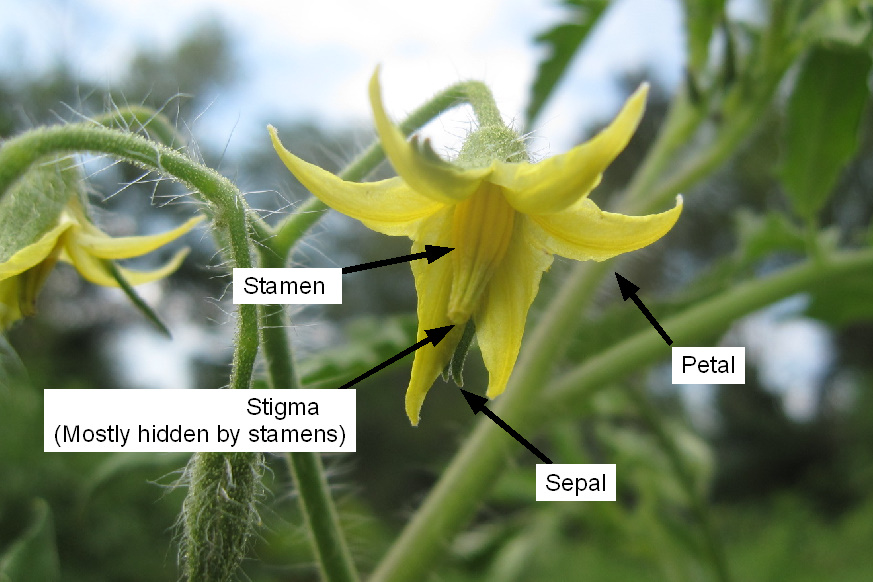
Tomato sex is all about the flower. Each flower has several layers: Green sepals that protect the developing bud, within them, yellow petals that attract pollinators. In the middle, forming a yellow cone, are the stamens, the male part of the flower that produces pollen (pollen = plant sperm) and in the very center surrounded by the stamens, the stigma (female). Sex happens and seeds are produced when pollen from the stamens gets on the stigma. Tomatoes are a bit odd in that they usually self pollinate -- they have sex with themselves. Usually, pollen from the anthers just falls down onto the stigma of the same flower, and hey presto, you get seeds that have just one individual as both their mother and father. Sometimes bees will carry pollen from one flower to another and mix things up, but it is fairly unusual.
In order to make two different tomato plants get together and make hybrid babies, you first need to prevent the mother of your hybrid babies from having sex with itself. So find a flower bud just about to open:
Using tweezers, carefully peal back the sepals and pull off the petals, to reveal the stamens. Those are the male parts of the flower, and they need to go. Hold the flower with one hand, and gently pinch and pull at the base of the stamens to peel them back to reveal the stigma hiding in the center of the flower.
This can be tricky. Tomato flowers are delicate, and it is easy to damage it in the process. Some varieties are easier to work with than others, so if one plant is giving you trouble, try a different one and see if it is any easier.

Once the stamens are out of the way, find a fully open flower from the other parent of your cross, and pull off one or two of its stamens.
You don't need to worry about damaging this flower -- all you need is the pollen, so you can rip it apart as much as you want. Once you've got a stamen, run your tweezer tip along the little groove on the inside.
 You'll see a little tiny bit of powdery, yellow pollen collect on your tweezer. (Yes, it is there in the picture -- click to enlarge if you can't see it.)

Gently dab this pollen onto the tip of the stigma of the first flower
(You can sing romatically or buzz like a bee as you do so, if you wish) and you have made your cross! Now just tie a string or something around it so you can find it again.
If you did everything right, the flower will develop into a tomato fruit, full of your F1 hybrid seeds. If you don't get fruit and seeds, you probably damaged the flower while pulling off the stamens. I usually do two or three flowers at a time to make sure I get at least one good one. When the fruit is ripe, collect your seeds, grow them out, and see what wonderful things you have created!

25 July 2010

On the radio

I am on NPR's food show, The Splendid Table this week! Check out this week's episode, I'm at the very end, after the call-in section, talking about my plan to breed a tomato named after the host, Lynne Rossetto Kasper.
 Who-hoo! I feel famous.

08 May 2010

My columbine collection

Carol, over at May Dreams Gardens, has been talking about her columbines, which makes me want to talk about MY columbine.

I'm a big columbine (Aquilegia) fan for several reasons. They're easy and adaptable, have gorgeous intricate flowers,  and are one of the few groups of plants that can do the whole range of red, yellow, blue and everything in between including brown, (almost) black, and green. Most of all, though, I love their promiscuous, self-seeding ways.

Regular readers may be beginning to realize that I am sort of obsessed with breeding plants. With most plants, you have carefully pollinate, then collect and grow seeds to get hybrids. But with columbine, just plant two varieties next to each other, and they'll do all the work: bees and humming birds will carry the pollen, and they'll seed the hybrid offspring around without any help from you. So, each year, when a new crop of seedlings comes into bloom, you just get to look through them and pick your favorites to let seed next year.

My current population of columbine is a combination of three groups of plants:

Aquilegia 'Perfumed Garden' which is my favorite commercial strain of columbine -- large flowers in a wide range of colors with a strong, honeysuckle scent. (Photo from Plant World Seeds)

Aquilegia 'Oranges and Lemons' which is a lovely range of oranges, reds, and yellows and theoretically is supposed to bloom all summer, though I haven't seen much rebloom on them yet. (Photo from Plant World Seeds)

Aquilegia viridiflora which has, I think, the most lovely shape of any columbine in the world, and also has a perfectly wonderful fresh, almost herbal scent. (My partner thinks they smell like Irish spring soap.) (Photo from B and T World Seeds)

These three have all been messing about in a most promiscuous fashion, so this year I have some lovely and interesting hybrids between them:
This one is, I think, a cross between 'Perfumed Garden' and A. viridiflora. The color is a little washed out, but the SCENT! It combines the honeysuckle smell of 'Perfumed Garden' and the fresh, herbal smell of A. viridiflora to great effect and is so strong I notice it just walking past. I hope some of the next generation keeps the fragrance, but has brighter colors and more of the shape of A. viridiflora.
This one combines the color of 'Oranges and Lemons' with the shape and scent of A. viridiflora. This has got to be one of the most elegant columbine flowers I've ever see -- such a sophisticated combination of yellow and purple-red, and what a perfect shape! I hope this one messes about with its more fragrant half-sister above, so I can combine these colors and perfect form with an even stronger, more wonderful scent.

By the way: If you are interested in growing more interesting, fragrant columbine next year, DO check out the selection from Plant World Seeds. They have a mind-boggling array of columbines unlike anything I've seen anywhere else. They are a UK company, but they ship to the US, and are well worth your time.

20 April 2010

Of plants and red delicious apples

I learned a lot of interesting things during my visit to California's Spring Pack Trials. One thing I learned is why my sweet potato vine wasn't actually a vine last summer. I picked it up at the garden center, placed it in a container, fully expecting it to explode forth in wild trailings. Instead, it sat there, a little purple-leaved blob, steadfastly refusing to vine anywhere. Not that there is anything wrong with little round plants -- but if I had wanted a little round dark leaved plant, I would have bought a coleus.
Last year I blamed the non-vining on me (did I not fertilize enough?) or the weather (it WAS an insanely cold summer) but now I know I should be blaming it on plant breeders.
You know how tomatoes become hard and flavorless? And peaches became dry and crunchy? Because plant breeders worked their hardest developing new varieties that are easy to grow and easy to ship -- ignoring the qualities that actually make peaches and tomatoes worth eating. Well, the same thing is happening to flowers. We visited over a dozen plant breeding companies during the trip, and everywhere we went, sales people touted how great their new varieties are. They told us how their sweet potato vine is the least likely to vine (because long vines get tangled and broken during shipping). They showed us marigolds with truly remarkable shipping tolerance (big marigold flowers tend to break off on the truck). A proud salesman held up their new agastache varieties next to the old so we could see the difference. The new ones had markedly smaller, less colorful flowers, BUT: They were short and compact.
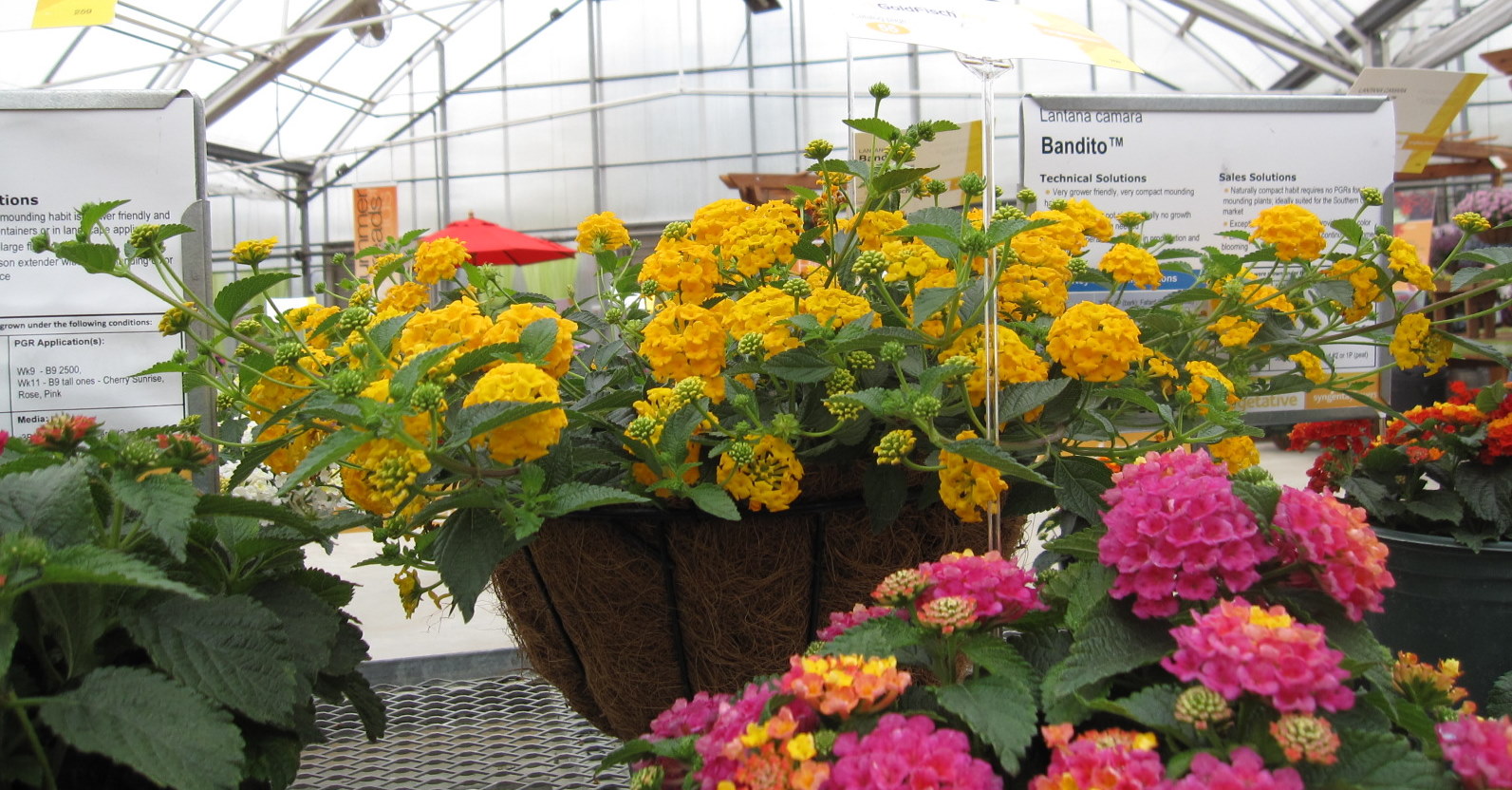
At Syngenta, they've changed lantanas from loose and spreading:

To dense and round:

And here is a mandevilla that, yep, you guessed it, never vines. You don't have to provide a trellis during production, raved our tour guide. Too bad for the gardener who buys it because they WANT it to cover a trellis.

Admittedly, gardeners carry a lot of the blame for this. We saw some gorgeous plants which everyone agreed would be hard to sell. For example, here is what the new Gomphrena 'Fireworks' looked like in the annual trials at MSU last summer:

That loose, air habit is pure gold in the garden. In a pot, as it would be sold, however, it looks sparse -- a few long stems with smaller flowers at the tips. Most people don't know enough to buy plants for what they will look like once they fill in, they just grab what looks pretty on the bench at the garden center or big box store. What looks pretty on the bench is small, compact, rounded, with lots of flowers. What looks good in the garden is something looser, more spreading, so that instead of being a series of little round balls of flowers, a bed of plants that interact, branches, flowers, colors coming together to create a unified whole.

Coming away from this, I have a couple thoughts.

As a gardener, I am saddened. The wild, trailing habit of sweet potato vines is what made them so ridiculously popular in the first place. Now their best feature is being systematically removed.

I'm also hopeful. In the food world, educated consumers are gradually turning things around. Apples like Honey Crisps, which are more difficult to grow and ship, are starting to replace the mealy, bland, Red Delicious, which is easily grown and shipped, but not worth eating. More and more heirloom, and heirloom-style, tomatoes with real flavor are turning up. Hopefully the same thing will happen with flowers. Gardening is growing in popularity every year, and thanks to the internet, gardeners are becoming better and better educated. I think the trend will begin to turn back to varieties which have been bred for how they perform in the garden, not on the truck to a big box store.

I also have another perspective. I'm studying plant breeding, and plan to make my career in it. In order to make varieties which people will buy, will I be forced to breed plants which I don't think are worth growing? I hope not -- and I think not. When we were visiting Syngenta Flowers, the head buyer for Wal-Mart walked in. A cloud of sales people buzzed around him, showing him proudly how their breeders had managed to take every plant imaginable and give them all exactly the same, highly shippable, growth habit. Petunias, lantana, mandevilla that all look identical! Hurray! At Takii, however, we were showed around a lovely display garden, with plants actually growing in the ground. No Wal-Mart representative was in sight, but a sales person talked with authentic passion to a groups of independent garden center owners about designing with their varieties, and how to educated consumers about new varieties that might not look quite as impressive on the sales bench, but perform better in the real world. I think the future of plant breeding holds both: Big box stores will increasingly demand -- and get -- the flower equivalent of red delicious apples, while good garden centers will keep looking for and growing better plants that need a little more care, and might have an ugly-duckling stage.

Meanwhile, if anyone has a good, old, VINING sweet potato vine, I need cuttings.